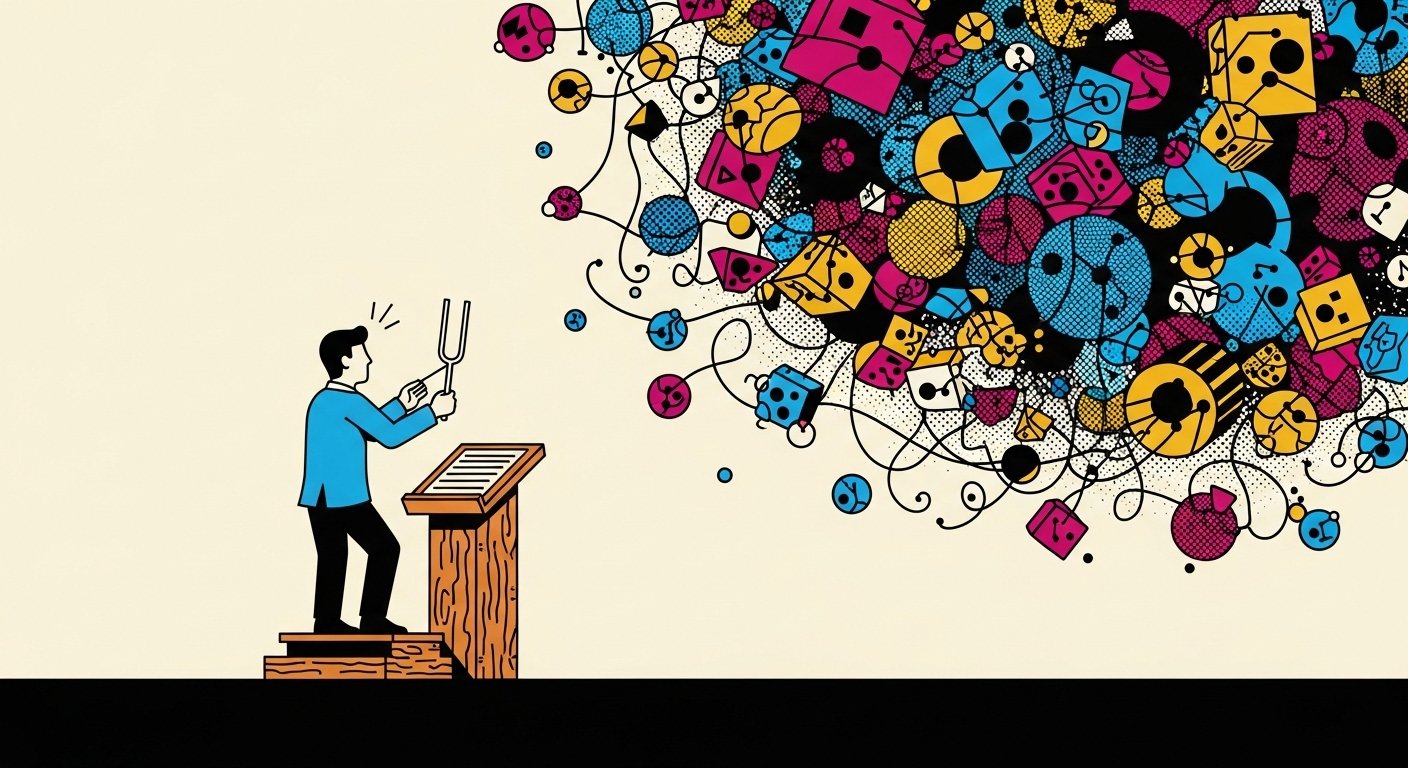
The Chief Digital Officer role was invented to solve a problem that no longer exists. In 2026, the CDO is no longer responsible for "doing digital" — they're responsible for orchestrating an enterprise-wide AI capability that most organisations don't yet understand they need. The job description hasn't kept pace with the reality, and that gap is quietly causing transformation programmes to collapse from the top down.
If your CDO is still primarily talking about cloud migration, app rationalisation, and "digital-first customer journeys," you may want to check whether the role is actually fit for purpose in 2026 — or whether you've promoted someone to manage a problem that has already moved on without them.
What Does a CDO Actually Do in 2026?
The honest answer: it depends entirely on the organisation, and that ambiguity is itself the problem. According to Gartner, only around 30% of CDOs have a clear, board-level mandate that extends beyond IT oversight and digital marketing. The rest are operating somewhere between "very senior project manager" and "expensive person who attends vendor demos."
The modern CDO mandate — done properly — looks like this:
- Orchestrating cross-functional AI adoption rather than simply deploying tools
- Establishing and owning AI governance, including ethical frameworks and regulatory compliance Breaking down data silos between departments that have spent a decade building them for entirely rational local reasons
- Leading the cultural change required to integrate autonomous AI agents into a workforce that, understandably, has some questions
- Acting as the strategic gatekeeper against SaaS sprawl and redundant technology procurement
That is, frankly, a lot. And most organisations are asking one person to do all of it, with a budget that reflects 2019 priorities and a team that was hired for a different era.
From Digitisation to Autonomous Orchestration: How Did We Get Here?
Phase 1: The Digitisation Era (roughly 2010–2018)
The early CDO's job was, in retrospect, relatively straightforward. Move things off paper. Put them on the internet. Build an app, ideally. Survive the organisational politics of telling the IT Director that "digital" wasn't just their department with a new name.
Success was measured in websites relaunched, PDF forms abolished, and the occasional CRM implementation that only went slightly over budget. The technology was hard. The people problems were manageable. The board was mostly impressed by dashboards.
Phase 2: The Platform Era (roughly 2018–2023)
Then came the platforms. Salesforce. ServiceNow. Microsoft 365 in all its sprawling, licence-heavy glory. The CDO's role shifted toward integration and data strategy — trying to make seventeen different systems talk to each other while the procurement team kept buying new ones.
This is the era that gave us the phrase "digital transformation," which, as I've noted elsewhere in this series, became so overused it stopped meaning anything at all. Every organisation was "on a digital transformation journey." Most of them were on a digital transformation car park.
Phase 3: The Agentic AI Era (2024–present)
Now we're here. Agentic AI — autonomous systems that don't just respond to prompts but plan, act, and chain decisions together — represents a fundamentally different operational challenge. This isn't a new tool to deploy. It's a new category of worker to manage.
The CDO who thrived in Phase 2 by mastering vendor relationships and integration architecture is not automatically equipped for Phase 3. The skills required have shifted dramatically toward governance, risk, human psychology, and cross-functional influence. The technology has become, if anything, the easier part.
Why Are So Many CDOs Still Fighting the Last War?
I've sat in enough executive steering committees to observe a consistent pattern: the CDO is presenting a roadmap that would have been genuinely impressive in 2021. The board is nodding. Nobody is asking the obvious question, which is whether any of this connects to what the business will actually need in eighteen months.
There are three structural reasons for this:
1. The mandate was defined at the point of hire
Most CDOs were hired to solve a specific problem — usually a legacy infrastructure crisis or a lagging digital customer experience. The job description was written for that moment. It wasn't designed to evolve, and neither were the KPIs attached to it.
So the CDO optimises for what they're measured on, which is increasingly disconnected from where the real transformation risk now sits.
2. The board doesn't know what to ask for
According to McKinsey's 2024 State of AI report, fewer than 25% of boards feel confident in their ability to evaluate AI strategy. That's not a criticism — the technology has moved fast, and board composition doesn't refresh overnight. But it does mean that the CDO operates with limited scrutiny at the top, which is not always a healthy environment for strategic clarity.
When nobody upstairs is asking hard questions, it's very easy to keep presenting the comfortable answers.
3. The "digital" in CDO has become a liability
The word "digital" now carries so much legacy baggage that it actively obscures what the role should be doing. Some organisations have quietly retitled the position — Chief AI Officer, Chief Data and Analytics Officer, Chief Transformation Officer — which is either a meaningful signal of strategic evolution or just a rebrand with better slides. Often it's hard to tell.
What matters is not the title. It's whether the person in the role has the mandate, the capability, and the organisational authority to do what actually needs doing.
The Cross-Functional Mandate: Why Silos Are Now an Existential Problem
The CDO's most important capability in 2026 is not technical. It is the ability to operate across departmental boundaries that were built, over many years, by people with entirely good intentions and entirely local incentives.
Finance protects its data because it's been burned before. Legal holds AI deployment at arm's length because the regulatory picture is genuinely uncertain. Operations wants productivity tools but not if they disrupt workflows that took three years to stabilise. HR is worried about what "AI augmentation" actually means for headcount.
Every one of these concerns is legitimate. The CDO's job is not to override them — it's to create the conditions under which they can be resolved without a six-month committee process.
The shift to product-led organisational models
Forward-thinking organisations are moving toward product-led structures — cross-functional teams organised around business outcomes rather than functional departments. Instead of "the IT team builds it and hands it to the business," you get multidisciplinary squads with embedded technology, commercial, and operational expertise working toward a shared goal.
The CDO in this model is less a department head and more an internal capability architect — setting the standards, building the platforms, and ensuring that every product team has access to the governance, data, and tooling they need without having to reinvent it themselves.
This is, incidentally, what an AI Centre of Excellence is supposed to do. But that's a topic for another article in this series.
Why the Best CDOs Focus on Human Psychology First
I've worked with organisations where the CDO had a genuinely excellent technical strategy and a genuinely catastrophic adoption rate. The technology was sound. The people were not on board. The project, as a result, was a very expensive proof-of-concept that proved nothing except that mandating change from the top without bringing people with you is a reliable way to waste money.
The best CDOs I've encountered treat workforce psychology as a first-order strategic concern, not an afterthought. They understand that the question "how do we get people to use this?" is not an HR problem or a comms problem — it is the transformation problem.
What this looks like in practice
- Involving end-users in tool selection before the contract is signed, not after
- Creating visible, low-stakes opportunities to experiment with AI tools without the experiment being attached to a performance review
- Naming and addressing the fear directly — particularly around job security — rather than papering over it with optimistic messaging about "augmentation"
- Celebrating productive failure as a signal that the organisation is learning, not flailing
- Building internal communities of practice where early adopters can share what's working without being perceived as management plants
None of this is complicated. All of it is consistently underinvested in.
Overcoming SaaS Bloat and Integration Paralysis
Every enterprise technology landscape I've encountered eventually becomes what I've come to think of as the Museum of Good Intentions. Every exhibit represents a procurement decision that made sense at the time. Some of the exhibits talk to each other. Most do not. The entrance fee was enormous and the café is closed.
The average mid-market enterprise is now running somewhere between 130 and 200 SaaS applications, according to BetterCloud's 2024 State of SaaS Operations report. Many of these overlap in function. Some were bought by departments that no longer exist. A meaningful proportion are being actively used by fewer people than the organisation is paying licences for.
The CDO's role as strategic gatekeeper is one of the most politically difficult parts of the job, because it requires saying no to colleagues who have already decided what they want to buy. This is not a popular position. It is, however, a necessary one.
A practical framework for rationalisation
- Audit current usage — not what licences you hold, but what is actually being used, by whom, and for what purpose
- Map against capability gaps — identify where genuine needs are unmet versus where tools are duplicating existing functionality
- Establish procurement governance — no department-level SaaS purchases above a defined threshold without CDO sign-off
- Define the integration requirement upfront — any new tool must demonstrate how it connects to existing data architecture before approval
- Review annually — SaaS sprawl is a recurring condition, not a one-time problem
CDO Role Evolution: A Comparison Table
| Dimension | CDO 2018 (Digitisation Era) | CDO 2026 (Agentic AI Era) |
|---|---|---|
| Primary Focus | Moving processes online; app development | Orchestrating AI adoption; governing autonomous agents |
| Key Skills | Project management; vendor relationships; UX | Cross-functional influence; risk governance; change psychology |
| Board Relationship | Reporting on delivery milestones | Advising on AI risk, compliance, and strategic investment |
| Technology Relationship | Primary decision-maker on tools | Strategic gatekeeper; sets standards, others execute |
| Success Metric | Features shipped; systems migrated | AI adoption rates; measurable business outcomes; governance maturity |
| Data Responsibility | Owns the data strategy on paper | Accountable for data readiness, lineage, and quality in practice |
| Organisational Model | Functional department (digital team) | Embedded across product-led, cross-functional squads |
| Biggest Risk | Project overruns; poor adoption of new tools | Regulatory non-compliance; shadow AI; workforce disengagement |
What Does Good Actually Look Like?
In my experience — and I've been sitting in these rooms for over twenty years, which is either a credential or a cry for help — the CDOs who drive genuine transformation share a small number of observable characteristics.
They are genuinely curious about the business, not just the technology. They can explain what the operations team is worried about and why the finance director is resistant, without framing either as irrational. They have political capital, and they spend it carefully.
They are comfortable with ambiguity in a way that isn't performance. The technology landscape in 2026 is genuinely uncertain. The regulatory environment is shifting. The competitive implications of agentic AI are not yet fully understood. A CDO who presents false certainty is either deceiving the board or themselves.
And they understand, with some clarity, that their job is to make themselves progressively less necessary at the operational level. The goal is an organisation where AI capability is embedded, governed, and continuously improving — not one that is dependent on a single individual's knowledge and relationships to hold it together.
That last point, in my experience, is the hardest one for most CDOs to genuinely internalise. But it's the one that separates the transformers from the maintainers.
Frequently Asked Questions
What is the difference between a CDO and a CTO in 2026?
The CTO (Chief Technology Officer) typically owns the technology infrastructure, engineering capability, and technical architecture. The CDO (Chief Digital Officer) owns the business application of that technology — how it drives outcomes, how people adopt it, and how it connects to commercial strategy. In practice, the boundary varies enormously between organisations. The key test: if AI adoption fails, who is accountable? In a well-structured organisation, that's the CDO.
Do all organisations need a CDO?
Not necessarily by that title. Smaller organisations often distribute the CDO's responsibilities across the CEO, CTO, and a strong Head of Product or Operations. What every organisation deploying AI at scale genuinely needs is someone with a cross-functional mandate to govern adoption, manage risk, and drive cultural change — whether that sits in a dedicated role or not.
What qualifications should a CDO have in 2026?
Formal qualifications matter less than demonstrated capability. Look for evidence of successful cross-functional change programmes, not just technology deployments. Experience with AI governance, data strategy, and regulatory compliance is increasingly important. Critically, look for someone who can talk to the board about risk and to frontline staff about fear — and be credible in both conversations.
How should a CDO measure their own performance?
Beyond the obvious delivery metrics, the most meaningful measures are: AI adoption rates across the organisation (not just in the digital team), data quality and governance maturity, time from AI pilot to production deployment, and — honestly — whether the workforce trusts the transformation. That last one is hard to quantify but very easy to observe.
What is "shadow AI" and why is it the CDO's problem?
Shadow AI refers to employees using AI tools — generative AI assistants, automation platforms, AI-enhanced software — without organisational knowledge, governance, or approval. It's the 2026 equivalent of shadow IT. It's the CDO's problem because the data security, compliance, and reputational risks land with the organisation, not with the individual who pasted sensitive client data into a public LLM on a Tuesday afternoon. Preventing it requires governance and culture, not just policy.
How long does it take to transform a CDO function for the agentic AI era?
Honestly? Longer than most boards expect and shorter than most CDOs claim. A realistic governance and capability uplift programme runs twelve to eighteen months for a mid-market organisation. The technology components move faster; the cultural and structural changes take longer. Anyone promising a full transformation in ninety days is either working with a very small organisation or selling something.
Nicholas Hodder is a digital transformation and AI strategy adviser with over twenty years of experience leading technology programmes across enterprise, public sector, and mission-driven organisations. He works with boards and executive teams to align AI investment with genuine business outcomes — and occasionally explains why the transformation strategy that looked brilliant in the boardroom has quietly stopped working by the time it reaches the people it was supposed to help.
If you're reassessing the scope and capability of your digital leadership function, or wondering whether your current CDO mandate is fit for 2026, get in touch to discuss executive advisory and coaching services.