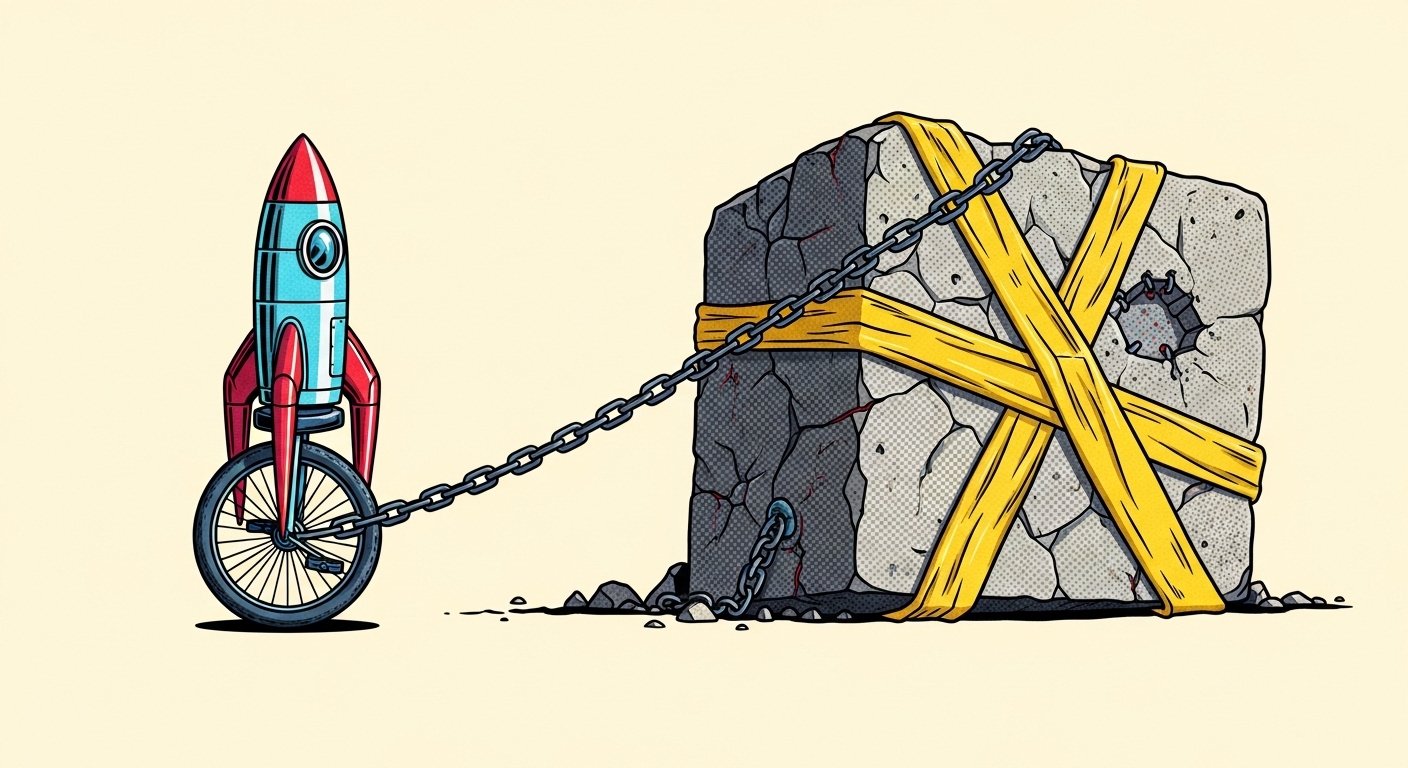
The most common reason enterprise AI deployments grind to a halt isn't the AI. It's the thirty-year-old ERP system sitting underneath it, duct-taped to a CRM that was "temporarily" integrated in 2011 and never revisited. Integrating AI — particularly the newer generation of autonomous, agentic AI — with legacy infrastructure requires a phased, API-driven approach that prioritises data architecture maturity before anything touches production systems.
If you're expecting this article to tell you to simply "modernise your stack," I'm afraid you've come to the wrong place. What follows is a practical, honest account of what integration actually involves, what tends to go wrong, and how to approach it without setting fire to the systems your business runs on.
What's the difference between generative AI and agentic AI — and why does it matter for legacy systems?
This distinction is worth nailing down early, because it changes the risk profile of everything that follows.
Generative AI (think: a chatbot, a summarisation tool, a content assistant) is largely passive. It takes an input, produces an output, and waits. A human decides what to do with the result. The blast radius of a bad response is usually limited to mild embarrassment or a slightly odd email.
Agentic AI is categorically different. An AI agent executes multi-step workflows autonomously — it doesn't just suggest the next action, it takes it. It might query a database, update a record in your CRM, trigger a purchase order, and send a customer notification, all without a human reviewing each step. That's genuinely useful. It's also genuinely dangerous if the systems it's interacting with weren't designed to handle autonomous actors.
Most legacy ERP and CRM platforms were built on the assumption that a human being sits between every significant transaction and its consequences. Agentic AI removes that assumption. If your data architecture isn't ready for that, you're not automating your business — you're automating your errors, at scale, faster than you can catch them.
Why do legacy system integrations fail when AI is introduced?
In my experience across financial services, public sector, and mid-market enterprise transformation programmes, the failure modes are remarkably consistent. They rarely come as a surprise to the technical teams. They almost always come as a surprise to the people who signed the business case.
The data architecture was never designed for real-time access
Legacy systems were typically built around batch processing — data moves in scheduled chunks, overnight or weekly. AI systems, particularly those supporting real-time decisions, need continuous, low-latency data streams. These two paradigms do not naturally coexist, and bridging them requires deliberate architectural work, not a middleware plugin and a prayer.
APIs either don't exist or weren't meant for this
Many legacy platforms were built before API-first design was standard practice. Some have APIs bolted on retrospectively — technically functional, but fragile under load and poorly documented. Connecting an autonomous agent to an API that was designed to handle five calls per minute from a human-operated interface is the enterprise technology equivalent of asking someone to use a cat flap as a front door.
Data silos mean the AI is working with an incomplete picture
If your customer data lives in three different systems that have never been reconciled, an AI agent operating across them will encounter contradictions it cannot resolve. It will either make a decision based on partial information, or it will fail. Neither outcome is acceptable in production.
No one owns the integration layer
This one is organisational rather than technical, but it's where projects go to die. The AI team assumes the data team has sorted the pipelines. The data team assumes the infrastructure team has provisioned the environments. The infrastructure team is waiting on a procurement decision. Meanwhile, the AI is sat in a sandbox, performing impressively in demos, wondering why it's never been allowed near anything real.
How do you assess whether your organisation is ready to integrate AI with legacy systems?
Before any vendor is engaged and before any proof of concept is commissioned, a data architecture maturity assessment is non-negotiable. I've seen organisations skip this step in the interests of speed and spend twelve months undoing the consequences. The assessment doesn't need to be a six-month consultancy engagement — but it does need to be honest.
The key questions to answer are:
- Can your core systems expose data via documented, stable APIs?
- Do you have a unified data layer (a data warehouse, data lakehouse, or equivalent) that aggregates operational data into a single, queryable source?
- Is your data labelled, governed, and subject to lineage tracking — meaning you know where it came from, what's been done to it, and who owns it?
- Do you have real-time or near-real-time data streaming capability, or are you entirely dependent on batch processing?
- Are your data privacy controls documented and enforced at the infrastructure level, not just in policy documents?
If the answer to more than two of those is "not really" or "it depends who you ask," the integration work needs to start with the data infrastructure, not the AI model.
What does a phased approach to legacy integration actually look like?
The word "phased" gets used a lot in transformation programmes, usually to mean "we'll figure out the hard bits later." That is not what I mean. A genuine phased approach sequences the work in order of dependency, so each phase creates the conditions for the next one to succeed.
Phase 1: Audit and stabilise the data foundation
This is the unglamorous work. You are identifying data sources, resolving inconsistencies, establishing ownership, and documenting what exists. The output is not a new system — it's an honest picture of what you're working with. Most organisations find this phase reveals problems they suspected but hadn't quantified.
Phase 2: Build or expose the integration layer
Using API gateways, middleware platforms, and event streaming tools (Apache Kafka, Azure Event Hub, and similar), you create a stable, monitored layer through which AI systems can access data without touching legacy databases directly. This layer acts as a buffer — it absorbs the complexity of legacy systems and presents a consistent interface to anything connecting to it.
This is also where low-code and no-code platforms can add genuine value. Tools like Microsoft Power Platform or MuleSoft allow integration workflows to be built and modified without requiring deep engineering resource for every change. They're not a replacement for proper architecture, but they reduce the cost of iteration significantly.
Phase 3: Deploy AI in read-only mode first
This is the principle that saves the most projects. Before an AI agent is permitted to write to, update, or trigger actions in production systems, it operates in a read-only, observational mode. It processes data, generates recommendations, and logs what it would have done — but a human reviews and executes. This builds confidence, surfaces edge cases, and creates an audit trail that will be invaluable when things eventually go wrong (and they will, in small ways, as they do with any new system).
Phase 4: Introduce write access with human-in-the-loop safeguards
When the read-only phase has generated sufficient confidence, write access is introduced — but with human-in-the-loop checkpoints on any action above a defined risk threshold. The threshold is set by the business, not the technology team. Automating a customer address update is low risk. Automating a supplier payment is not. The distinction matters.
Phase 5: Scale selectively based on evidence
The final phase is not "turn everything on." It's identifying which workflows have demonstrated consistent, measurable value in phases three and four, and expanding those specifically. This is how you avoid the pilot purgatory that kills most enterprise AI programmes — not by trying to prove everything at once, but by proving specific things conclusively and building from there.
What does a human-in-the-loop workflow look like in practice?
Human-in-the-loop (HITL) is a design principle, not a technology. It means that for defined categories of decision or action, the AI presents a recommendation or draft action, and a human being reviews and approves it before it executes.
In practice, this might look like:
- An AI agent drafts a contract renewal recommendation based on CRM data and usage analytics. A relationship manager reviews and sends it.
- An AI flags an anomalous transaction in a financial system. A compliance officer reviews before any account action is taken.
- An AI generates a procurement order based on inventory thresholds. A supply chain manager approves before it's submitted to the supplier.
The goal is not to have a human approve every action indefinitely — that defeats the purpose. The goal is to maintain oversight during the period when the system is being validated, and to preserve human judgment for decisions where the consequences of error are significant.
As Amy Edmondson's research on psychological safety in high-performing teams demonstrates, the organisations that catch errors earliest are those where people feel empowered to raise concerns without fear of blame. HITL workflows create the structural equivalent of that — a checkpoint where concerns can surface before they become incidents.
Legacy vs. Modern Architecture: A Practical Comparison
| Dimension | Legacy Architecture | AI-Ready Modern Architecture |
|---|---|---|
| Data access pattern | Batch processing (nightly/weekly exports) | Real-time streaming and event-driven pipelines |
| API availability | Limited or absent; often requires custom connectors | API-first design; documented, versioned, stable endpoints |
| Data governance | Informal; ownership unclear; lineage undocumented | Formal data catalogue; lineage tracked; ownership assigned |
| Integration complexity | High; point-to-point integrations, brittle dependencies | Managed via middleware/API gateway; loosely coupled |
| AI agent compatibility | Low; autonomous agents risk cascading errors | High; supports read/write access with audit logging |
| Change velocity | Slow; changes require significant re-engineering | Higher; containerisation and microservices enable iteration |
| Security model | Perimeter-based; assumes internal trust | Zero-trust; continuous verification for all actors including AI |
| Observability | Limited; errors surface after the fact | Unified monitoring; anomalies flagged in real time |
The honest read of this table is that very few organisations sit cleanly in the right-hand column. Most are somewhere in the middle, which is fine — the goal isn't perfection before you start, it's knowing where you are so you can sequence the work sensibly.
What role does containerisation play in legacy modernisation?
Containerisation — packaging an application and its dependencies into a portable, isolated unit (using tools like Docker or Kubernetes) — is one of the more practical tools available to organisations that need to modernise without replacing everything at once.
Rather than rebuilding a legacy system from scratch, you can containerise specific functions, run them alongside modern services, and gradually shift workloads. It's not a silver bullet, but it does allow the organisation to innovate at the edges without destabilising the core. Think of it as renovating a kitchen while still living in the house — inconvenient, but considerably less disruptive than demolishing the building.
The critical caveat: containerisation requires operational maturity to manage. Kubernetes in particular has a steep learning curve. If your infrastructure team is already stretched, adding container orchestration without adequate resource is a way of creating new complexity rather than reducing existing complexity.
How do you maintain security when AI agents interact with legacy systems?
Legacy systems were not designed with AI agents in mind. They were designed with human users in mind — users who authenticate once, operate within a defined role, and generally behave predictably. An AI agent operating across multiple systems, making multiple calls per second, presents a fundamentally different security challenge.
The principles that apply here are:
- Zero-trust architecture: Every access request — from a human or an AI agent — is verified, regardless of where it originates. There is no implicit trust based on network location.
- Least-privilege access: AI agents are granted only the permissions they need for the specific task they're performing. An agent handling customer communications has no business accessing financial records.
- Identity management for AI agents: Agents need their own identities, credentials, and audit trails — separate from the human users they might be acting on behalf of.
- Immutable audit logging: Every action taken by an AI agent is logged in a tamper-proof record. When something goes wrong — and it will — you need to be able to reconstruct exactly what happened.
This is not optional governance bureaucracy. In the context of the EU AI Act and UK GDPR, demonstrating that you have oversight and control over autonomous systems is a regulatory requirement, not a nice-to-have.
What are the most common mistakes organisations make when integrating AI with legacy systems?
I've observed enough of these programmes to have a fairly well-worn list. None of these will surprise anyone who has lived through one. All of them are preventable.
- Treating the integration as an IT project rather than a business transformation. The business stakeholders disengage after the requirements workshop, and the technical team builds something technically correct that nobody uses.
- Underestimating data cleaning timelines. Data cleaning is always slower and more expensive than estimated. Always. Build in a contingency and then add another one.
- Deploying agentic AI before read-only validation is complete. The pressure to demonstrate value is real, but the cost of an autonomous agent making erroneous writes to a production system is considerably higher than the cost of a few more weeks in observation mode.
- Choosing middleware based on vendor relationships rather than architectural fit. The middleware your incumbent vendor is pushing may not be the right tool for the integration you're attempting. Evaluate on merit.
- Neglecting the people who operate the legacy systems. The teams who live in these platforms every day know where the bodies are buried. Their knowledge is invaluable. Ignoring them in favour of a clean-room technical assessment is how you end up discovering undocumented dependencies in production.
Frequently Asked Questions
How long does it typically take to integrate AI with legacy ERP systems?
Honestly, it depends almost entirely on data architecture maturity and organisational readiness. A well-governed, API-accessible ERP with clean data might support a meaningful integration in three to six months. A fragmented, batch-processed system with multiple data owners and no unified layer is more likely to be an eighteen-month to two-year programme before AI is operating reliably in production. Anyone who tells you otherwise is either selling something or hasn't done it.
Do we need to replace our legacy systems entirely before deploying AI?
No — and in most cases, attempting to do so simultaneously is a recipe for both projects failing. A phased approach that builds an integration and data layer on top of existing systems is significantly less risky than a full replacement programme. The exception is where the legacy system is so fundamentally broken that no integration layer can compensate — in which case, you have a larger problem that predates the AI question.
What is middleware and do we actually need it?
Middleware is software that sits between two systems and manages communication between them — translating data formats, managing API calls, handling errors, and providing a stable interface regardless of what's happening in the underlying systems. In most enterprise AI integration scenarios, yes, you need some form of it. The alternative — direct point-to-point connections between AI systems and legacy databases — is brittle, difficult to monitor, and extremely painful to change.
How do we handle data privacy when AI agents are accessing customer data in legacy systems?
This requires both technical and governance controls. Technically: data masking, tokenisation, and access controls that prevent AI agents from accessing personally identifiable information (PII) beyond what's required for the specific task. From a governance perspective: a clear data processing agreement that covers AI agent activity, documented under your UK GDPR obligations. If your legacy system doesn't support granular access controls, that's a data architecture problem that needs resolving before AI agents are introduced.
What is the difference between a data warehouse and a data lakehouse?
A data warehouse stores structured, processed data optimised for querying and reporting — it's fast and reliable but less flexible for raw or unstructured data. A data lakehouse combines elements of a data warehouse and a data lake, allowing both structured and unstructured data to be stored and queried from a single platform. For AI and machine learning workloads, the lakehouse architecture is increasingly preferred because it supports the variety of data types that modern models require. The right choice depends on your existing infrastructure, data volumes, and the specific AI use cases you're pursuing.
How do we know when an AI agent is ready to move from read-only to write access?
The threshold should be defined before the read-only phase begins, not after. Typically, this involves: a defined period of observation (at minimum several weeks in a representative production environment), a documented error rate below an agreed threshold, successful human review of a statistically significant sample of agent recommendations, and sign-off from both the technical and business owners. The decision should be evidence-based, not schedule-based.
Nicholas Hodder is a digital transformation and technology leader with over 20 years of experience delivering complex programmes across financial services, public sector, and mission-driven organisations. He advises boards and leadership teams on AI strategy, legacy modernisation, and the human side of technology change. If your AI integration programme has stalled, or you're trying to work out where to start, get in touch to discuss an Architecture and Integration Strategy Review.