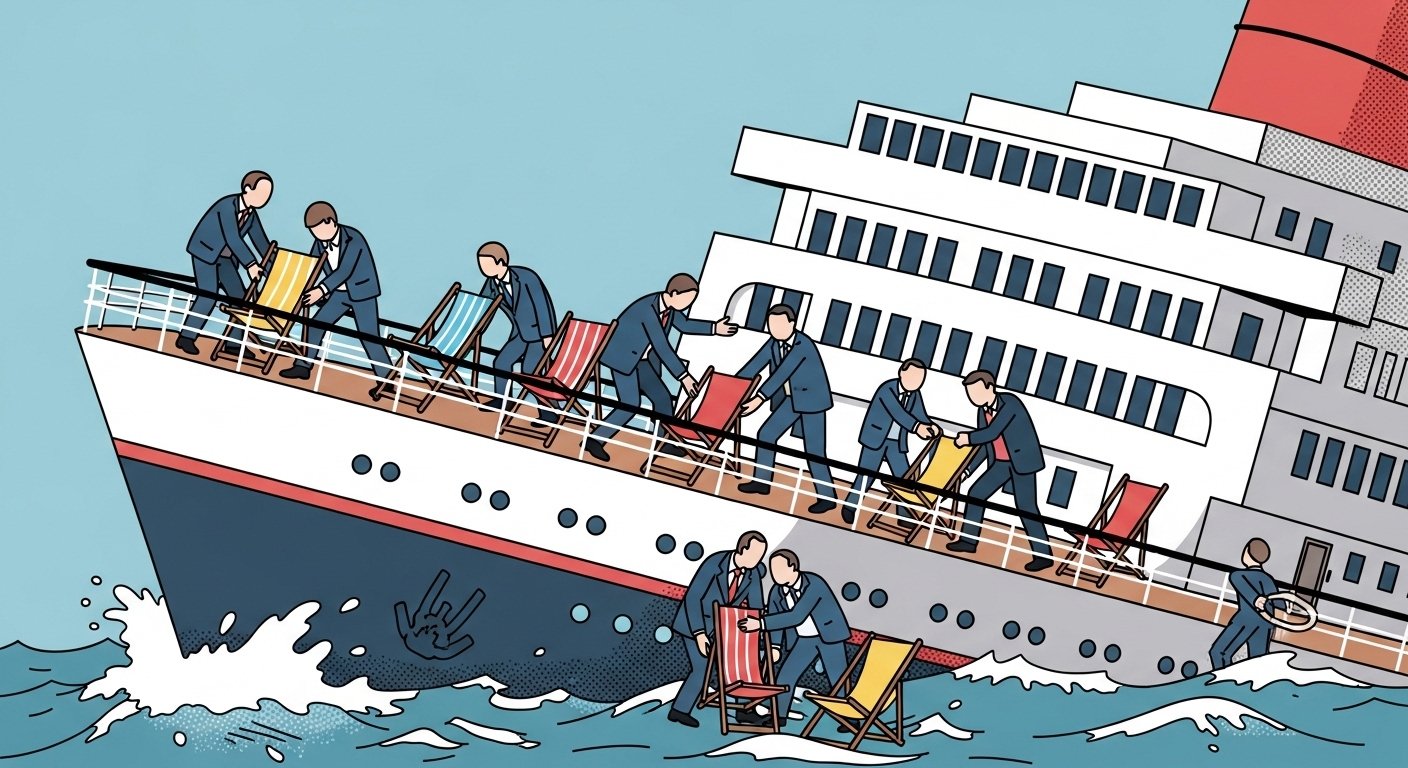
Most enterprise AI projects don't fail dramatically — they fade. They drift from promising pilot to permanent "proof of concept" status, consuming budget and goodwill in roughly equal measure, until someone quietly stops mentioning them in steering committee updates. According to McKinsey, fewer than 30% of enterprise AI initiatives scale beyond the pilot stage. The reasons are almost never technical.
The fix requires three things done in the right order: an honest data readiness audit, a clear line of sight between the AI deployment and a specific business outcome, and — most importantly — genuine leadership on the cultural side. Skip any one of those and you're just rearranging deck chairs on a very expensive proof of concept.
What does "enterprise AI failure" actually look like?
It rarely looks like a catastrophic system crash. More often it looks like a Slack channel called #ai-innovation that nobody posts in anymore, and a vendor relationship that's technically still active but spiritually over.
The pattern is consistent across organisations I've worked with: a period of genuine excitement, a pilot that produces encouraging but inconclusive results, a growing inability to demonstrate ROI to the finance director, and then a slow institutional forgetting. The project doesn't get cancelled — that would require a decision. It simply stops being talked about.
Gartner coined the term "pilot purgatory" for exactly this phenomenon. It's where AI projects go when they've proven they can work in a controlled environment but nobody has figured out how to make them work in the real one.
The three blockers that put projects into pilot purgatory
- Fragmented data infrastructure: The AI has been trained on clean, curated pilot data that bears no resemblance to the messy, siloed, inconsistently formatted reality of production systems.
- Absent governance: Nobody owns the thing. There's no clear decision-maker, no defined success criteria, and no escalation path when something goes wrong.
- Cultural resistance: The people who are supposed to use the tool have quietly decided they don't trust it, don't understand it, or simply don't want to change how they work — and nobody has addressed that directly.
The uncomfortable truth is that most organisations treat AI failure as a technology problem. It almost never is.
Why is data the most common reason AI projects fail?
Because data problems are invisible until they're catastrophic. A model trained on incomplete or poorly labelled data will produce confident-sounding outputs that are subtly or dramatically wrong. And unlike a broken spreadsheet formula, nobody puts a red border around an AI hallucination.
According to IBM's Global AI Adoption Index, 74% of companies report significant challenges scaling AI value — and the primary obstacle cited is data quality and accessibility, not model capability. The models are generally fine. The data feeding them is not.
The specific data problems that cause model drift and hallucinations
- Siloed data: Customer data lives in the CRM. Operational data lives in the ERP. Financial data lives in a spreadsheet on someone's desktop. The AI sees fragments and fills the gaps with guesswork.
- Poor labelling: Training data that hasn't been consistently categorised produces models that can't reliably distinguish between what matters and what doesn't.
- No data lineage: When a model produces a wrong answer, nobody can trace back through the data pipeline to understand why. Debugging becomes archaeology.
- Volume mismatches: The pilot dataset was 10,000 records. Production involves 10 million, with edge cases the model has never encountered.
Model drift — where a model's accuracy degrades over time as real-world data diverges from its training set — is particularly insidious because it happens gradually. The outputs don't suddenly become wrong; they become slightly less right, week by week, until the business has quietly stopped trusting them without quite knowing when that happened.
Is cultural resistance really as significant as technical failure?
In my experience, it's more significant. I've seen technically excellent AI deployments fail because the team using them felt threatened, confused, or simply not consulted. And I've seen technically mediocre tools succeed because someone took the time to bring people along.
A 2024 survey by Salesforce found that 35% of businesses cite lack of expertise as a primary barrier to AI adoption. But expertise gaps are solvable with training. What's harder to solve is the ambient anxiety that AI creates in a workforce that hasn't been given a clear and honest account of what it means for their jobs.
What does cultural resistance actually look like in practice?
It looks like shadow IT — employees using unauthorised AI tools because the official one doesn't fit their workflow, creating data governance nightmares in the process. It looks like passive non-compliance: the tool is technically deployed, but people have found workarounds that mean they never have to engage with it meaningfully.
It looks like a middle manager who nods along in every meeting about AI adoption and then goes back to their team and says nothing, because they're not sure whether to be enthusiastic or worried, and defaulting to silence feels safest.
The absence of psychological safety — the confidence that experimenting with new tools and occasionally failing won't reflect badly on you — is the single most underrated obstacle in digital transformation. It doesn't appear on any risk register. It absolutely should.
How do you actually rescue a stalled AI project?
Start by stopping. Not permanently — but before you add more technology, more consultants, or more optimistic slide decks, you need an honest audit of where you actually are.
In my work with organisations across the public and private sectors, I use what I call a Culture-First Recovery Framework. It runs in four stages, and the order matters.
Stage 1: Diagnose honestly, not charitably
Bring in an independent perspective — internal politics have usually already shaped the official narrative by this point. The questions you need answered are: What was the original business problem this was supposed to solve? Is that problem still relevant? And does anyone currently using this tool believe it's helping them do their job better?
That last question is the one most post-mortems skip. It's also the most useful.
Stage 2: Audit the data before touching the model
Map your data sources. Identify where the silos are. Understand what data the model was trained on versus what it's being asked to process in production. This is not glamorous work — it's closer to auditing a filing system than launching a moonshot — but it is the work that determines whether everything else succeeds.
- Document data lineage: where does each data source come from, who owns it, and when was it last validated?
- Identify and resolve labelling inconsistencies in training data.
- Establish automated data quality monitoring so drift is caught before it corrupts outputs.
- Create a single source of truth by unifying operational, experiential, and external data flows wherever possible.
Stage 3: Redefine success in terms finance will recognise
One of the reasons AI projects lose executive support is that their success metrics were defined in technical terms nobody outside the data team understands. If you can't explain the ROI of your AI deployment in plain English in under two minutes, you haven't defined it properly yet.
Tie every metric to a specific business outcome: reduced processing time, lower error rates, faster customer response, measurable cost reduction. Implement unified observability — a single dashboard that tracks model performance alongside business KPIs — so the connection between technical health and business value is always visible.
Stage 4: Address the human side directly and specifically
This is where most recovery plans fall apart. Leaders acknowledge that "change management is important" and then do nothing that actually constitutes change management.
Practical steps that actually move the needle:
- Identify and empower internal champions — people at the coal face who've found genuine value in the tool and can speak credibly to their peers.
- Create explicit psychological safety by celebrating experimentation, not just success. When someone tries something with the AI and it doesn't work, that needs to be treated as useful information, not a performance issue.
- Be honest with the workforce about what the technology does and doesn't do. Vague reassurances ("AI will help you do your job better!") breed more anxiety than transparency about specifics.
- Give people agency in the implementation. The teams closest to the work usually know exactly why the tool isn't fitting their workflow. Ask them. Then act on what they say.
What's the difference between an AI project that scales and one that doesn't?
In my observation, the projects that scale all share one characteristic: someone in a leadership position made the business outcome their personal responsibility, not the technology outcome. They weren't asking "is the model performing well?" They were asking "is this making us measurably better at the thing we're trying to do?"
The projects that stall have usually been handed to the most technically capable person available, who then optimises for technical metrics while the business case quietly evaporates around them.
AI is not an IT project with a larger budget. It is a business transformation that happens to involve technology. The distinction sounds semantic. It is not.
Comparing common AI rescue approaches
| Approach | What it addresses | What it misses | Best suited for |
|---|---|---|---|
| Technology refresh (swap the model/vendor) | Capability gaps, outdated tooling | Data quality, cultural resistance, governance | Projects where the model is genuinely the bottleneck (rare) |
| Data remediation sprint | Siloed data, poor labelling, drift | Leadership alignment, end-user adoption | Projects with strong sponsorship but poor data foundations |
| Change management programme | Workforce resistance, shadow IT | Technical and data infrastructure issues | Projects with solid tech but low adoption rates |
| Culture-First Recovery Framework | All three blockers in sequence | Requires genuine leadership commitment and time | Projects in genuine pilot purgatory with no clear path forward |
| Project cancellation and restart | Sunk cost fallacy, misaligned scope | Root cause analysis — same problems will recur | Projects where the original business case was never valid |
How do you know if it's worth rescuing or better to start again?
Honestly? Ask whether the original business problem is still real and still worth solving. If the answer is yes, the project is almost always worth rescuing — because the institutional knowledge, the vendor relationships, and the lessons learned from the pilot all have value, even if the outputs don't yet.
The only scenario where I'd recommend a clean restart is when the project was built around a solution looking for a problem — where someone got excited about a technology and worked backwards to justify it. In that case, you're not rescuing a failing project; you're prolonging a category error.
The tell-tale sign: ask five people involved in the project what business problem it was designed to solve. If you get five different answers, you have your answer.
Frequently Asked Questions
Why do over 70% of AI projects fail to scale?
The most consistent reasons are data infrastructure fragmentation, absence of clear governance and ownership, and cultural resistance from the workforce. Technical model failure is a distant fourth. Most organisations underinvest in data readiness and change management while overinvesting in model selection and vendor evaluation.
What is "pilot purgatory" in AI projects?
Pilot purgatory describes the state where an AI project has demonstrated it can work under controlled conditions but cannot be scaled to production. The pilot produces encouraging results; the business case for scaling cannot be clearly articulated; the project neither progresses nor gets cancelled. It simply consumes resources indefinitely.
How long does it take to rescue a failing AI project?
A realistic recovery timeline depends on the severity of the data infrastructure issues, but a structured recovery programme typically takes between three and nine months to move a stalled project to production-ready status. The data remediation phase is usually the longest. Cultural shifts, counterintuitively, can move faster — if leadership is genuinely committed.
What is model drift and why does it matter?
Model drift occurs when the statistical properties of real-world data diverge from the data the model was trained on, causing accuracy to degrade over time. It matters because it's gradual and therefore easy to miss. By the time an organisation notices the outputs are unreliable, the model may have been making subtly wrong recommendations for months.
How do you measure the ROI of an AI project that has stalled?
Define ROI in terms of specific, pre-agreed business outcomes — not model performance metrics. What was the operational problem? What would measurable improvement look like in terms the finance director recognises? Implement unified observability to track both technical performance and business KPIs in a single view, so the relationship between the two is always legible.
What is shadow IT in the context of AI adoption?
Shadow IT refers to technology tools used by employees without official organisational approval or oversight. In the AI context, this typically means staff using consumer-grade generative AI tools — ChatGPT, Gemini, Claude — for work purposes because the officially approved tools don't meet their needs. This creates significant data governance and compliance risks.
How do I get leadership buy-in to rescue a failing AI project?
Reframe the conversation around the original business problem, not the technology investment. Leaders who have lost confidence in an AI project have usually lost confidence in the technology narrative, not in the underlying business need. Demonstrate a clear, costed path from current state to measurable outcome, with defined milestones and a governance structure that assigns accountability explicitly.
Nicholas Hodder is a digital transformation and technology leadership consultant with over 20 years of experience working with organisations across the private, public, and heritage sectors. He specialises in rescuing stalled AI programmes and building the cultural conditions for sustainable innovation.
If your AI project has stopped moving forward and you're not sure whether to push, pivot, or quietly put it out of its misery — book an AI Transformation Audit. It's a structured, independent review of where your programme actually is, what's blocking it, and what a realistic path forward looks like. No slide decks full of buzzwords. Just an honest assessment and a workable plan.