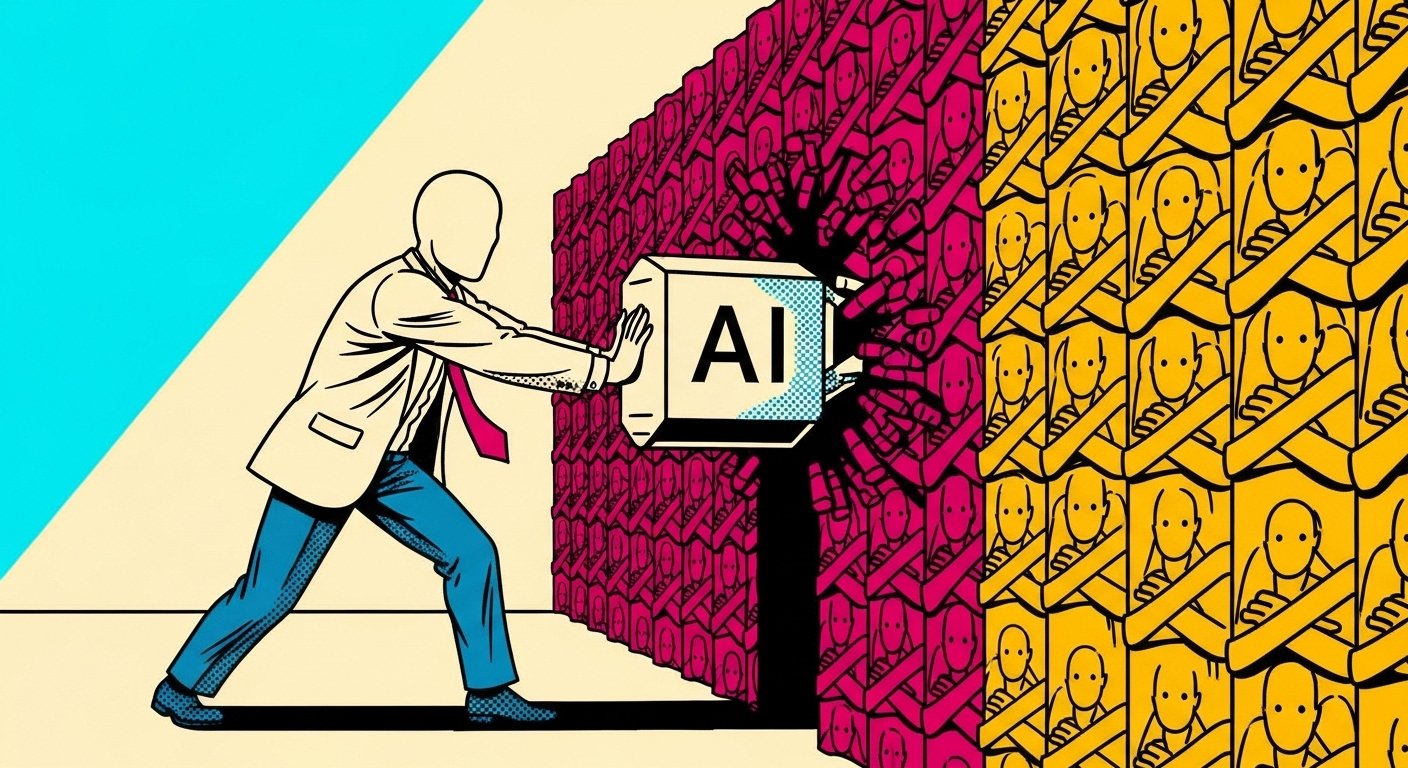
The uncomfortable truth about digital transformation failure
Most enterprise AI projects don't fail because of the technology. They fail because the people asked to use it were never given a reason to trust it — or the leaders mandating it. If your AI adoption rates are disappointing, the problem is almost certainly not your software licence.
Cultural resistance is consistently cited as one of the top three barriers to AI adoption across UK enterprises. And yet most transformation programmes spend roughly 80% of their budget on technology and about 20% on the humans who are supposed to operate it. The maths, as they say, doesn't math.
This article is about fixing that ratio — not in a "have you tried a town hall?" way, but in a structured, measurable, strategically serious way.
Why do employees resist AI adoption in the first place?
The short answer: because nobody asked them if they wanted it before it arrived.
The longer answer involves three overlapping dynamics that most transformation programmes either ignore or misdiagnose as laziness.
Fear of redundancy (which is rarely irrational)
When an organisation announces an AI implementation without addressing job security, employees fill the silence with their own conclusions. And given the volume of headlines about automation displacing workers, you can hardly blame them. Silence from leadership isn't neutrality — it's a vacuum that anxiety fills extremely efficiently.
A 2023 IBM Institute for Business Value study found that 42% of employees reported concerns that AI would make their skills obsolete. If your transformation programme hasn't explicitly addressed this, you haven't addressed it.
The competence threat
There's a particular kind of dread that comes from being asked to use a tool you don't understand in front of colleagues who might notice. It's the professional equivalent of being handed a remote control with forty buttons and told to present the quarterly figures. When people feel exposed, they don't experiment — they retreat to what they know.
This is especially acute in mid-career professionals who have built genuine expertise over years and suddenly find themselves positioned as novices again. Dismissing this as ego is both uncharitable and strategically useless.
Learned helplessness from previous failed rollouts
If your organisation has a history of mandating new systems that were quietly abandoned eighteen months later, your employees have already drawn the correct lesson: wait it out. This isn't resistance — it's rational behaviour based on evidence. You can't solve a trust deficit with a product demo.
What is psychological safety, and why does it matter for AI adoption?
Psychological safety — a term coined by Harvard Business School professor Amy Edmondson — refers to the belief that one can speak up, experiment, and make mistakes without facing punishment or humiliation. In the context of AI transformation, it means employees feel safe enough to try new tools, ask "stupid" questions, and report when something isn't working.
This isn't a soft, HR-flavoured nice-to-have. It has a direct, measurable impact on your transformation outcomes.
Google's internal Project Aristotle research, which studied hundreds of teams over several years, found that psychological safety was the single most important factor in team effectiveness — more important than individual talent, seniority, or technical skill. Teams that felt safe to fail were the teams that actually delivered.
In a transformation context, the absence of psychological safety produces a specific and recognisable set of symptoms:
- Low engagement with new AI tools despite mandatory training
- Parallel "shadow IT" systems where employees quietly use familiar workarounds
- Reporting that inflates adoption metrics while actual usage remains minimal
- High attrition among the people you most need to retain
I've walked into organisations where the official AI adoption rate was 78% and the actual meaningful usage was closer to 12%. Those twenty-odd percentage points represent the cost of a culture that punishes failure.
Why top-down technology mandates almost always backfire
There is a particular type of executive who genuinely believes that if you buy the right tool and send a sufficiently stern all-staff email, transformation will follow. I've met many of them. They are, without exception, confused about why their transformation programmes keep stalling.
Mandating adoption without building the conditions for it is the organisational equivalent of installing a gym in the office and being surprised that nobody lost weight. The equipment isn't the problem.
The compliance trap
When adoption is mandated rather than earned, you get compliance rather than engagement. People log in, click around, and log off. They complete the training module. They do not change how they work. Compliance is the lowest possible form of adoption, and it produces none of the productivity gains you were promised in the business case.
The shadow IT problem
Employees who can't get what they need from officially sanctioned tools will find alternatives. Sometimes this means using consumer-grade AI tools for tasks involving sensitive company data — a governance and security nightmare that most IT teams discover far too late. Shadow IT isn't a technology problem; it's a signal that your official solution isn't meeting a real need.
According to Gartner, by 2027 shadow AI — the unsanctioned use of generative AI tools — will account for more than 40% of enterprise AI usage. That figure should concentrate minds at board level.
What does "culture-first" actually mean in practice?
It means you build the human infrastructure before — or at least in parallel with — the technical infrastructure. Not as a bolt-on communications exercise, but as a genuine strategic commitment.
In my work with organisations across the public and private sectors, I use a framework I call People → Process → Technology. The sequence matters. Most organisations run it backwards.
Step 1: Diagnose before you prescribe
Before any AI tool is selected or deployed, conduct a genuine cultural readiness assessment. This means talking to the people who will actually use the thing — not just the senior stakeholders who approved the budget. Find out what they're afraid of, what they don't understand, and what problem they actually need solving.
This is not a focus group. It's structured intelligence gathering. You are looking for the real blockers, not the official ones.
Step 2: Make failure visible and unremarkable
Leaders need to model the behaviour they want to see. If you want your team to experiment with AI tools, you need to visibly experiment yourself — and visibly get things wrong. A senior leader saying "I tried this, it didn't work, here's what I learned" is worth more than any adoption campaign.
This is harder than it sounds for people who have spent careers projecting confidence. But it is non-negotiable if you want a culture that learns.
Step 3: Reframe roles, don't just add tasks
One of the most common mistakes in AI transformation is asking people to use AI tools on top of their existing workload rather than instead of parts of it. This communicates, loudly, that AI is additional burden rather than genuine augmentation. If you want people to embrace AI, show them specifically what it takes off their plate — not what it adds to it.
Step 4: Create structured spaces for experimentation
Designate time and permission for teams to explore AI tools without immediate pressure to produce results. This doesn't require a lavish innovation lab — it requires protected time and explicit permission to try things that might not work. Innovation without permission isn't innovation; it's risk-taking on someone else's behalf.
Can you actually measure the financial return on psychological safety?
Yes. Not perfectly, and not in isolation — but the evidence is substantial enough to build a business case around.
| Metric | Low Psychological Safety | High Psychological Safety | Source / Basis |
|---|---|---|---|
| Employee turnover | Higher voluntary attrition, especially among high performers | Significantly lower turnover; reduced recruitment costs | Gallup State of the Global Workplace, 2023 |
| AI tool adoption rate | Surface-level compliance; low meaningful usage | Genuine integration into workflows; measurable productivity gains | McKinsey Global AI Survey, 2024 |
| Error reporting | Problems hidden until they become costly failures | Early detection; lower cost of failure | Edmondson, The Fearless Organization, 2018 |
| Innovation output | Incremental suggestions; risk-averse decision-making | Higher volume of ideas; faster iteration cycles | Google Project Aristotle, 2016 |
| Shadow IT risk | High; employees seek unsanctioned workarounds | Lower; needs met through official channels | Gartner AI Governance Report, 2024 |
The case isn't that psychological safety is a nice cultural flourish. The case is that its absence has a direct, traceable cost — in wasted software licences, failed transformations, and talent walking out the door.
How does this change when we're talking about agentic AI?
Agentic AI — autonomous systems that can plan, reason, and execute multi-step tasks without human intervention at each stage — raises the cultural stakes considerably. This isn't just about people learning to use a new interface. It's about people fundamentally renegotiating their relationship with their own work.
When an AI agent can draft, review, send, and follow up on communications autonomously, the human's role shifts from executor to orchestrator. That's a significant identity shift, and it doesn't happen smoothly just because the technology is ready.
The "orchestrator" transition requires active support
Moving from doing the work to directing an agent that does the work requires new skills, new confidence, and a new understanding of where human judgement adds value. Organisations that deploy agentic AI without investing in this transition will find their humans and their agents working in parallel rather than in concert — which is considerably more expensive than either on its own.
The psychological safety question here is acute: if an AI agent makes a consequential error, who is accountable? If that question doesn't have a clear, fair answer, the humans in the loop will either disengage or micromanage — neither of which is what you paid for.
A practical framework: de-stigmatising failure in AI transformation
Here is the approach I use with organisations that are serious about building this capability — not as a culture programme sitting alongside the transformation, but as the foundation of it.
1. Audit the current culture honestly
- Run anonymous surveys and structured interviews to understand actual (not reported) attitudes toward AI
- Map where fear, confusion, and cynicism are concentrated — usually in specific teams or reporting lines
- Identify the informal leaders who will either accelerate or undermine adoption
2. Establish a clear narrative about job impact
- Be explicit about which roles will change, how, and over what timeframe
- Commit to reskilling pathways before deployment, not after resistance emerges
- Avoid the word "augmentation" without showing specifically what it means for each role
3. Build in structured experimentation time
- Allocate protected time (even 90 minutes per fortnight) for teams to explore AI tools
- Remove performance pressure from this time — it is learning time, not delivery time
- Share learnings across teams, including the failures
4. Reward the behaviour, not just the outcome
- Recognise and celebrate teams that tried something new, regardless of whether it worked
- Make the cost of inaction visible — not as a threat, but as honest strategic context
- Ensure that reporting structures don't punish people for raising problems with AI tools
What separates organisations that get this right from those that don't?
In my experience, it comes down to one thing: whether the senior leadership team genuinely believes that culture is a strategic variable, or whether they think it's something HR manages while the real work happens elsewhere.
Organisations that get AI transformation right tend to have leaders who are visibly curious, openly uncertain about some things, and willing to be seen learning in public. They treat the human layer of transformation with the same rigour they apply to the technical architecture.
Organisations that get it wrong tend to have leaders who are very confident about the technology and completely uninterested in why their teams aren't more excited about it.
Those two postures are, in my experience, the most accurate predictor of transformation success — more reliable than budget size, technology choice, or implementation partner.
Frequently asked questions
How long does it take to build psychological safety in a team?
There's no universal timeline, but meaningful shifts in team behaviour are typically observable within three to six months of consistent, deliberate effort from leadership. The key word is consistent — episodic interventions don't build trust; sustained behaviour does.
What's the difference between psychological safety and just being nice to people?
Psychological safety is about candour, not comfort. A psychologically safe team can have difficult conversations, challenge ideas, and disagree openly — because the culture supports it. A team that's merely "nice" often suppresses exactly those conversations, which is how you end up with problems that nobody mentioned until they became expensive.
Can you build psychological safety remotely or in hybrid teams?
Yes, but it requires more deliberate effort. Informal trust-building that happens naturally in physical proximity doesn't occur spontaneously on video calls. Leaders in hybrid environments need to be more explicit about creating safe spaces for experimentation and more attentive to the signals that indicate someone is disengaging.
How do you handle employees who are genuinely resistant rather than just anxious?
First, distinguish between resistance and anxiety — they look similar but require different responses. Genuine resistance (as opposed to fear) is relatively rare and usually has a specific cause: a previous bad experience, a principled objection, or a legitimate concern about the technology. Engage with the concern rather than the behaviour. Mandating compliance from a resistant employee doesn't change their mind; it just drives the resistance underground.
Is psychological safety relevant in organisations that are under financial pressure?
Particularly relevant. Under pressure, organisations need people to surface problems early, try new approaches quickly, and be honest about what isn't working. These are exactly the behaviours that psychological safety enables and that fear suppresses. The organisations that most need honest information are often the ones that have most successfully prevented people from sharing it.
What's the ROI calculation for a culture-first transformation programme?
The most straightforward calculation combines: reduced attrition costs (typically £10,000–£30,000 per replaced employee depending on seniority), faster time-to-adoption for AI tools (measured against baseline), and reduced shadow IT risk exposure. A reasonable estimate for a mid-sized organisation (500–2,000 employees) is that a 10% improvement in genuine AI adoption rates generates productivity value equivalent to two to three times the cost of the culture programme. The caveat: these figures require honest baseline measurement, which most organisations haven't done.
Nick Hodder is a digital transformation and technology leader with over 20 years of experience working with enterprises, public sector bodies, and cultural institutions across the UK. He advises boards and leadership teams on the human side of technology adoption — the part that rarely appears in the vendor deck but consistently determines whether the investment pays off.
If your AI transformation programme is technically sound but culturally stalled, let's have a conversation about what's actually going on. A Leadership Workshop on Culture-First Transformation can be the most cost-effective intervention your programme makes this year — get in touch to find out how.