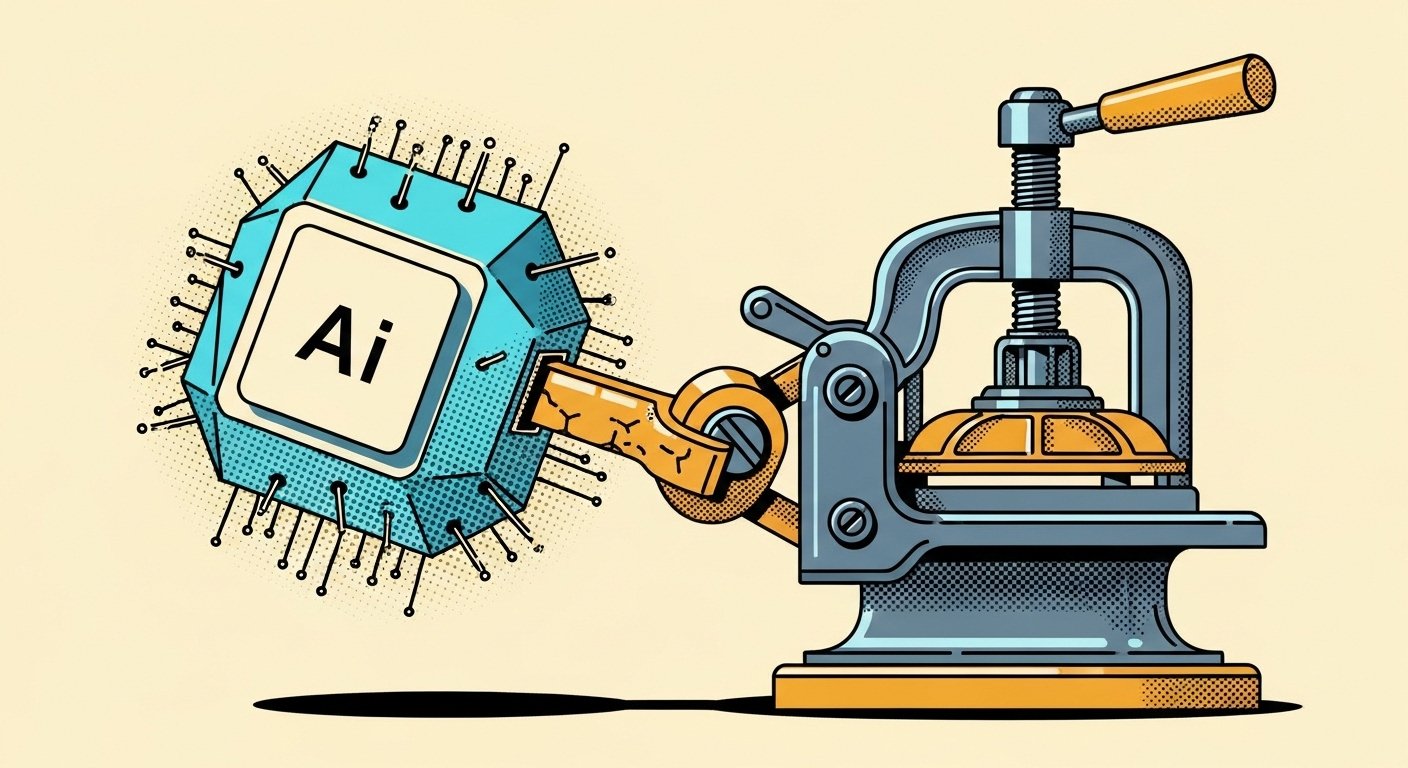
Integrating AI with legacy systems requires a phased, API-driven strategy that insulates fragile infrastructure from autonomous agents while progressively modernising the data architecture underneath. You do not rip and replace. You do not bolt a large language model onto a 2003 ERP system and hope for the best. You build carefully, you instrument everything, and you keep humans in the loop at every decision point that actually matters.
If your organisation has already read the governance frameworks, understood why AI projects fail, and accepted that culture comes first — this is where the conversation gets technical. Not intimidatingly so, but honestly so. Because a compelling AI pilot that makes it to production-grade deployment almost always trips over a legacy integration problem wearing a data problem's coat.
What Is Agentic AI, and Why Does It Make Legacy Integration More Dangerous?
Agentic AI refers to autonomous AI systems capable of executing multi-step tasks, making decisions, and triggering actions across connected systems — without a human approving each step. This is categorically different from a chatbot that answers questions or a model that summarises a document.
A generative AI tool that drafts a supplier email is a passive assistant. An agentic workflow that reads your CRM, identifies a lapsed contract, drafts the renewal email, schedules a follow-up in the calendar, and updates the opportunity stage in Salesforce — that is an agent. It is doing things, not just saying things.
The distinction matters enormously when your CRM is connected to a legacy billing system from 2008 that nobody fully understands, has no sandbox environment, and runs on a server in a cupboard in Swindon. An agent that makes a mistake in that environment does not just produce a wrong answer. It potentially writes to production data, triggers downstream processes, or corrupts records that take weeks to unpick.
"I have seen organisations give an AI agent write-access to a live ERP system within six weeks of their first proof-of-concept. The confidence was impressive. The subsequent incident report was not." — Nick Hodder
Why Do So Many AI-Legacy Integration Projects Stall?
According to McKinsey's 2024 State of AI report, 72% of organisations cite integration with existing systems as a primary barrier to scaling AI. That figure has barely shifted in three years, which tells you something: this is not a problem the market is solving on your behalf. It requires deliberate architectural choices made by people who understand both the AI layer and the legacy layer — which is, admittedly, a fairly rare combination.
The failure modes tend to cluster around three familiar culprits.
Fragmented data architecture
Legacy systems were not designed to share data. They were designed to do one thing reliably, in isolation, for a long time. The result is an estate of systems that hold overlapping, contradictory, and poorly-labelled records across formats that would make a data engineer visibly sad. AI models trained or operating on this data do not produce better insights. They produce confident-sounding nonsense — what the industry politely calls hallucinations, and what I call "expensive wrong answers."
No API layer, no integration surface
Many legacy systems — particularly in mid-market manufacturing, financial services, and public sector — have no modern API (Application Programming Interface) layer. Connecting AI tooling to them requires either risky direct database access, brittle screen-scraping workarounds, or a middleware project that balloons in scope within a fortnight.
Governance that arrives after the architecture
Organisations build the integration first and ask the governance questions second. By that point, the agent has already been given more access than it should have, the audit trail is incomplete, and the compliance team is asking questions that nobody in the room can answer with any confidence.
What Does Your Organisation's Data Architecture Maturity Actually Look Like?
Before any AI integration work begins, it is worth being honest about where you actually are. The table below maps four common maturity levels against their AI integration readiness and the realistic intervention required at each stage.
| Maturity Level | Typical Characteristics | AI Integration Readiness | Required Intervention Before AI Deployment |
|---|---|---|---|
| Level 1 – Fragmented | Siloed systems, manual data exports, no shared identifiers, batch processing only | Very Low | Data audit, master data management programme, API gateway introduction |
| Level 2 – Emerging | Some integration exists (point-to-point), partial API coverage, inconsistent data quality | Low to Moderate | Unified data catalogue, middleware layer, data quality monitoring tooling |
| Level 3 – Managed | Centralised data platform, real-time feeds in some domains, documented lineage | Moderate to High | Human-in-the-loop workflow design, sandbox environments, observability layer |
| Level 4 – Optimised | Event-driven architecture, real-time data streams, automated quality monitoring, full lineage | High | Governance policy enforcement, agentic access controls, continuous model monitoring |
Most mid-market enterprises I work with land somewhere between Level 1 and Level 2, which is not a criticism — it is simply the reality of twenty years of organic IT growth. The error is not being at Level 1. The error is attempting to deploy agentic AI as though you are at Level 4.
What Is the Right Phased Approach to Legacy System Modernisation?
The word "phased" gets used so frequently in transformation programmes that it has almost lost meaning. What I mean by it here is specific: each phase must have a defined exit criterion before the next phase begins. Not a timeline. A criterion. If the data quality does not meet the threshold, you do not proceed. Full stop.
Phase 1: Audit and Isolate (Weeks 1–8)
- Conduct a comprehensive data audit across all systems that the AI will need to read from or write to.
- Identify data owners, document lineage, and flag inconsistencies and gaps.
- Map the existing system estate: which systems have APIs, which require middleware, which are genuinely too fragile to touch.
- Establish a sandbox environment — a non-production replica — for any system the AI will interact with. If a sandbox cannot be created, that system is off-limits to agentic workflows until it can be.
- Define your data governance policy before writing a single line of integration code.
Phase 2: Build the Integration Layer (Weeks 8–20)
- Introduce an API gateway or middleware layer (MuleSoft, Azure API Management, and AWS API Gateway are common enterprise choices) that mediates all AI-to-legacy communication.
- Migrate high-value, high-frequency data flows from batch processing to real-time event streams where technically feasible.
- Implement a unified data catalogue — a searchable inventory of all data assets, their owners, formats, and quality scores.
- Use low-code/no-code platforms (Power Platform, Zapier for enterprise, or similar) to prototype integrations before committing to bespoke development. These are not production solutions, but they are excellent for validating assumptions cheaply.
- Containerise legacy workloads where possible (Docker, Kubernetes) to create portability and reduce the risk of environment-specific failures.
Phase 3: Controlled Agent Deployment (Weeks 20–36)
- Deploy agentic workflows in read-only mode first. Let the agent observe, recommend, and log — but not act. This builds confidence and surfaces edge cases before they become incidents.
- Introduce write-access incrementally, starting with the lowest-risk, most reversible actions.
- Implement unified observability (Datadog, Dynatrace, or equivalent) to monitor agent behaviour, flag anomalies, and track downstream effects on connected systems.
- Define and enforce consumption caps — limits on how many actions an agent can take in a given period — to prevent runaway automation.
Phase 4: Scale and Optimise (Ongoing)
- Expand successful agent workflows to adjacent use cases, using the established governance framework as the template.
- Continuously monitor model performance and data quality, flagging drift before it corrupts operational outputs.
- Conduct quarterly architecture reviews to retire redundant point solutions and prevent SaaS bloat (the accumulation of overlapping tools that nobody can quite justify removing).
How Do You Design Human-in-the-Loop Workflows That Actually Work?
Human-in-the-loop (HITL) is a design principle that ensures a human reviews, approves, or can override AI decisions at defined points in an automated workflow. It is not a concession to technophobia. It is sound engineering practice for any system operating in a complex, consequential environment.
The challenge is that most HITL implementations are either too permissive or too restrictive. Too permissive: the agent acts autonomously in scenarios where the stakes are genuinely high, and the human only sees the output after the fact. Too restrictive: the agent requires human approval for every micro-decision, at which point you have automated the paperwork and not the work.
Designing effective HITL checkpoints
The right approach is to map every action in an agentic workflow against two dimensions: reversibility and consequence. Actions that are easily reversible and low-consequence (drafting a document, generating a report, categorising a record) can be automated with post-hoc review. Actions that are difficult to reverse or carry significant downstream consequence (writing to a financial ledger, sending external communications, modifying customer records) require pre-action human approval.
- Define decision authority clearly in writing — not as a verbal agreement, but as a documented policy. Who can approve what, at what threshold?
- Build override capability into every workflow. Any human should be able to halt, roll back, or redirect an agent's action without requiring IT intervention.
- Log everything. Every agent decision, every action taken, every human override. This is not bureaucracy — it is the evidence base you need when something goes wrong, and the audit trail you need for regulatory compliance.
- Review the checkpoints regularly. As confidence in the system grows, some manual approvals can be safely automated. As the system encounters new edge cases, some automated steps may need to revert to human review. HITL is a living design, not a one-time configuration.
Comparing Integration Approaches: What Are Your Actual Options?
| Integration Approach | Best Suited For | Strengths | Risks | Typical Cost Complexity |
|---|---|---|---|---|
| Direct Database Access | Internal read-only analytics on stable systems | Fast to implement, no middleware cost | High risk of data corruption; no audit trail; bypasses application logic | Low upfront, very high incident risk |
| API Gateway / Middleware | Most enterprise integration scenarios | Decoupled, secure, auditable, scalable | Requires API availability on legacy systems; middleware can become a single point of failure | Medium-High |
| Event-Driven Architecture | Real-time data processing, high-volume workflows | Highly scalable, decoupled, enables real-time AI inference | Significant architectural investment; requires mature DevOps capability | High |
| Low-Code Integration Platforms | Prototyping, SME environments, non-critical workflows | Fast to deploy, accessible to non-developers | Vendor lock-in; performance ceilings; governance gaps at scale | Low-Medium |
| Robotic Process Automation (RPA) | Legacy systems with no API, repetitive UI-based tasks | Can integrate with almost anything; no code changes to legacy system | Brittle to UI changes; not suitable for complex decision-making; high maintenance burden | Medium |
There is no universally correct answer here. The right approach depends on your system estate, your risk appetite, your in-house capability, and — most importantly — what you are actually trying to achieve. Anyone who tells you otherwise is selling you something.
What About Security? Doesn't Connecting Legacy Systems to AI Create New Vulnerabilities?
Yes. Bluntly: yes. Every integration point is a potential attack surface, and legacy systems were not designed with modern threat models in mind. This is not a reason to avoid integration — it is a reason to do it properly.
Zero-trust architecture — the principle that no system, user, or agent is trusted by default, and every access request is continuously verified — should be the governing security model for any AI-to-legacy integration. This means:
- Assigning the AI agent the minimum permissions required for its defined tasks (principle of least privilege).
- Implementing multi-factor authentication and identity verification for agent access, not just human access.
- Encrypting data in transit and at rest across all integration points.
- Conducting regular penetration testing on the integration layer, not just the perimeter.
- Establishing clear data residency and sovereignty policies — particularly important if your AI vendor processes data outside the UK or EU.
We will cover the full cybersecurity picture in a dedicated article in this series. For now, the principle is simple: security architecture must be designed into the integration from the start, not retrofitted after the incident.
Frequently Asked Questions
How long does it realistically take to integrate AI with a legacy ERP system?
Honest answer: between four and eighteen months, depending on the maturity of your data architecture, the availability of APIs on the legacy system, and the complexity of the workflows you are automating. Vendors who quote six weeks are describing a proof-of-concept, not a production deployment. Do not confuse the two.
Do we need to replace our legacy systems before deploying AI?
Not necessarily, and often not advisable. A full system replacement is expensive, disruptive, and takes years. A well-designed API and middleware layer can enable AI integration without touching the legacy system itself. The goal is to build a modern integration surface around the legacy core, not to rip it out. That said, if a system genuinely cannot support any form of integration and holds critical data, a replacement programme may eventually be unavoidable.
What is the difference between RPA and agentic AI?
Robotic Process Automation (RPA) follows rigid, pre-defined rules to automate repetitive tasks — typically mimicking what a human would do in a user interface. It is deterministic and brittle. Agentic AI uses large language models and reasoning capabilities to plan, adapt, and execute multi-step tasks dynamically. It is far more capable and far more dangerous if deployed without appropriate guardrails. RPA is a useful tool for legacy systems with no API; agentic AI requires a more robust integration foundation.
What does "data lineage" mean, and why does it matter for AI?
Data lineage refers to the documented history of a piece of data — where it originated, how it has been transformed, and where it has flowed across systems. For AI, this matters enormously: if a model is producing inaccurate outputs, data lineage is how you trace the problem back to its source. Without it, debugging a misbehaving model is approximately as productive as trying to identify a smell in a large open-plan office.
How do we handle AI integration in a hybrid cloud and on-premise environment?
Hybrid environments are genuinely complex, and anyone who tells you otherwise has not worked in one recently. The key principles are: ensure consistent identity and access management across cloud and on-premise systems; use a unified observability platform that spans both environments; and avoid building integrations that create hard dependencies between cloud-native AI tooling and on-premise systems without a clear failover strategy. Containerisation (packaging applications so they run consistently across environments) significantly reduces the friction here.
What is "model drift" and how does it affect legacy integrations?
Model drift occurs when an AI model's performance degrades over time because the real-world data it is operating on has changed, while the model itself has not been updated to reflect that change. In a legacy integration context, this is particularly common when the underlying data quality in legacy systems fluctuates — seasonal patterns, process changes, or upstream data issues can all cause a previously well-performing model to produce increasingly unreliable outputs. Automated data quality monitoring and regular model revalidation are the mitigations.
Nick Hodder is a digital transformation and technology leader with over 20 years of experience delivering enterprise change programmes across the public, private, and third sectors. He advises boards and executive teams on AI strategy, legacy modernisation, and the organisational conditions required to make technology investments actually work.
If you are navigating an integration challenge between modern AI tooling and legacy infrastructure — or you have inherited someone else's attempt at one — get in touch to discuss an Architecture and Integration Strategy review. The first conversation is always free. The subsequent honesty may cost you slightly more, but it will be considerably cheaper than the alternative.