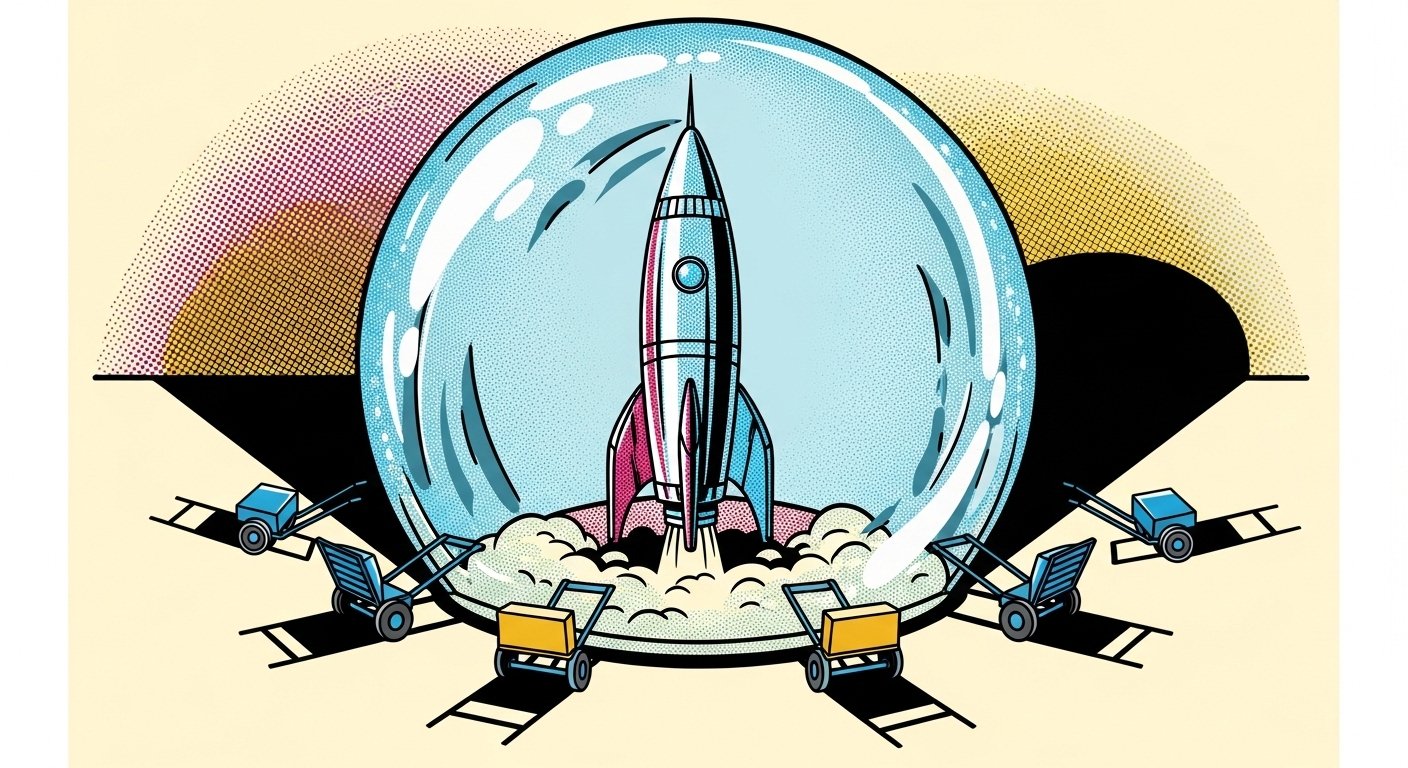
Psychological safety is not a soft concept. It is, in practical terms, the single most reliable predictor of whether your workforce will actually use the technology you just spent six figures procuring. When employees feel safe to experiment, ask stupid questions, and fail without career consequences, AI adoption accelerates. When they don't, you get shadow IT, quiet workarounds, and a very expensive piece of software that nobody opens after the launch-day all-hands.
Most digital transformation programmes fail not because the technology was wrong, but because the culture was never ready for it. That's the uncomfortable truth that vendors won't put in their pitch decks.
Why Does Cultural Resistance Kill Digital Transformation?
The standard enterprise technology rollout follows a familiar arc. A leadership team — inspired by a conference, a Gartner report, or a particularly persuasive sales lunch — procures a new platform. A project manager is assigned. A launch date is set. And then, somewhere between the training webinar and the go-live, the whole thing quietly dies.
Not with a bang. With a shrug.
People revert to spreadsheets. They find workarounds. They nod along in steering committees and then do exactly what they were doing before. This isn't sabotage — it's a completely rational human response to being handed a tool that nobody asked for, without being told why it matters or given permission to get it wrong while learning.
According to McKinsey, 70% of digital transformation programmes fail to meet their stated objectives. The most commonly cited reason isn't technical debt or vendor failure. It's people and culture. The technology, in most cases, works fine. It's the humans that need the support.
What Is Psychological Safety, and Why Should a CDO Care?
Psychological safety, a concept developed by Harvard Business School professor Amy Edmondson, refers to the shared belief within a team that it is safe to take interpersonal risks — to speak up, ask questions, flag concerns, or admit you haven't a clue how the new AI tool works without fear of embarrassment or reprisal.
In the context of AI adoption, this matters enormously. Your workforce is being asked to change how they do their jobs, often dramatically, while simultaneously absorbing headlines about automation replacing entire professions. The anxiety is real. The resistance is logical. And if leadership responds to that anxiety with mandates rather than empathy, adoption collapses.
I've sat in enough transformation steering committees to recognise the pattern: leadership interprets slow adoption as laziness or stubbornness, doubles down on enforcement, and then expresses genuine surprise when engagement metrics crater. It's a bit like responding to someone's fear of flying by moving their seat closer to the engine.
Why Do Top-Down Technology Mandates Universally Fail?
The mandate model — "everyone will use this tool by Q3, it's in the OKRs" — has a seductive logic to it. It's decisive. It signals commitment. It gives the transformation programme a measurable deadline that looks good on a board slide.
It also, reliably, does not work.
Here's what actually happens when you force software onto a workforce that hasn't bought into the why:
- Compliance theatre: People log in, click around, and close the tab. Usage metrics look acceptable. Actual behaviour hasn't changed.
- Shadow IT proliferation: Employees find tools they prefer — often consumer-grade, ungoverned, and outside your security perimeter — and use those instead. Your data governance team finds out six months later.
- Talent attrition: High performers, who have options, leave environments where they feel surveilled, pressured, and unsupported. The people who stay are often those with fewer alternatives.
- Learned helplessness: After enough failed rollouts, teams stop engaging with new tools entirely. The "here we go again" eye-roll becomes the default response to every transformation initiative.
The mandate model treats adoption as a compliance problem. It isn't. It's a trust problem.
What Does Psychological Safety Actually Look Like in Practice?
This is where the concept tends to go a bit vague in leadership literature, so let me be specific. Psychological safety in a digital transformation context means four concrete things:
1. Leaders Who Model Uncertainty Publicly
If your senior leadership team presents every AI initiative as fully formed and obviously correct, your workforce learns that expressing doubt is career-limiting. The most effective transformation leaders I've worked with are those willing to say, in a room full of people, "I don't know how this will play out — let's figure it out together."
This isn't weakness. It's the fastest way to get honest signal from the people closest to the actual work.
2. Structured Permission to Fail
Not vague encouragement to "be innovative," but explicit, time-boxed, resourced spaces to experiment without the results feeding into performance reviews. Rapid experimentation only happens when the cost of a failed experiment is genuinely low. If people suspect that a botched pilot will be mentioned in their appraisal, they won't run the pilot. They'll wait for someone else to go first.
3. Transparent Communication About Job Impact
The elephant in every AI adoption conversation is the question nobody feels safe asking out loud: "Is this going to replace me?" Leaving that question unanswered doesn't make the fear go away. It just means people answer it themselves, usually pessimistically, usually incorrectly, and definitely in the group chat you're not part of.
Address it directly. Be honest about what will change, what won't, and what support is available. The organisations that handle this well don't avoid the conversation — they own it early.
4. Rewarding Questions, Not Just Answers
In most corporate cultures, the reward system favours people who appear to know things. Asking a basic question about an AI tool in a meeting feels risky if the unspoken norm is that everyone should already know. Changing this requires explicit signals from leadership — publicly praising curiosity, sharing their own learning curves, and making it clear that the person who asks the "obvious" question is doing the team a service.
What's the Actual Financial Impact of Getting This Right?
Let's put some numbers around this, because "psychological safety is important" is the sort of thing that gets nodded at in workshops and then deprioritised when the budget conversation starts.
| Metric | Low Psychological Safety | High Psychological Safety | Source / Basis |
|---|---|---|---|
| AI Tool Adoption Rate | 20–35% sustained use after 90 days | 65–80% sustained use after 90 days | Gartner, 2024 Digital Adoption Benchmarks |
| Employee Turnover | Up to 3× higher during transformation | Turnover aligned with sector average | McKinsey Org Health Index |
| Time-to-Value on AI Pilots | 6–18 months to meaningful ROI | 3–6 months with engaged teams | Deloitte AI Institute, 2024 |
| Shadow IT Incidents | High — ungoverned tool proliferation | Low — governed, centralised tooling | IBM Security Cost of Data Breach Report |
| Innovation Pipeline | Ideas filtered upward slowly, if at all | Ground-level insight surfaces quickly | Google Project Aristotle findings |
The numbers are not subtle. A workforce that trusts the process and feels safe to engage is not a nice-to-have — it's a competitive advantage with a measurable return.
Google's own internal research — Project Aristotle — found that psychological safety was the single most important factor differentiating high-performing teams from average ones. Not skills. Not experience. Not the quality of the tools they used. Whether people felt safe enough to take risks together.
How Does Agentic AI Change the Stakes?
This is worth pausing on, because the nature of the threat — and therefore the nature of the fear — is shifting.
Agentic AI refers to autonomous AI systems capable of executing multi-step tasks independently: scheduling, researching, drafting, triaging, making decisions within defined parameters — without a human initiating each action. We've moved well beyond AI as a search engine upgrade. These systems are starting to do things that look, from the outside, quite a lot like work.
When the AI was just helping someone write a better email, the workforce could absorb it relatively comfortably. When the AI is autonomously managing a procurement workflow, the psychological stakes are different. The question shifts from "will this make my job harder?" to "will this make my job unnecessary?"
Leaders who don't address that shift explicitly are leaving a gap that anxiety will fill. The human role in an agentic AI environment is not disappearing — it's changing from executor to orchestrator. People need to understand that distinction, and they need to believe it, which means leadership has to demonstrate it through the decisions they actually make, not just the talking points they distribute.
Four Strategic Steps to De-Stigmatise Failure and Accelerate Adoption
Based on my work with organisations navigating large-scale AI transformation — from mid-market technology businesses to public sector bodies to cultural institutions — here's the framework I've found actually moves the needle:
Step 1: Run a Culture Audit Before You Touch the Tech Stack
Before you select a vendor, run a diagnostic on your organisation's current relationship with failure and change. Anonymous pulse surveys, structured interviews with frontline teams, and an honest look at how mistakes are currently handled will tell you more about your AI readiness than any technology assessment. If your culture punishes failure, your AI programme will fail before it starts.
Step 2: Identify and Empower Your "Psychological Safety Champions"
Every organisation has people — usually not at the top — who others trust, who are respected for their honesty, and who can model new behaviours without it looking like a management initiative. Find them. Give them the tools, the platform, and the explicit endorsement to lead peer-level conversations about change. Top-down messaging alone won't reach the people who've learned to be sceptical of top-down messaging.
Step 3: Design Experiments with Explicit Failure Budgets
Rather than asking teams to "try things," give them a structured framework: a defined time period, a clear hypothesis, agreed success criteria, and — critically — an explicit statement that a negative result is a valid and valuable outcome. An experiment that proves something doesn't work is not a failure. It's data. Treating it as such, publicly and consistently, changes the culture faster than any workshop.
Step 4: Close the Feedback Loop Visibly
Nothing erodes psychological safety faster than the sense that feedback disappears into a void. When teams raise concerns about a new AI tool, or flag a process that isn't working, leadership must visibly acknowledge it, respond to it, and — where possible — act on it. Even when the answer is "we've heard this, and here's why we're proceeding anyway," that's infinitely better than silence.
The organisations I've seen get this right treat feedback not as a complaint management exercise but as the most valuable data source they have. Because it is.
What About the Leaders Who Are Also Afraid?
Here's something that doesn't appear in enough transformation frameworks: senior leaders are often just as uncertain about AI as the people they're supposed to be reassuring. They've read the same breathless headlines, sat through the same vendor demos, and are trying to project confidence about a technology that is genuinely, rapidly, and somewhat unpredictably evolving.
The pressure to appear decisive and informed, while privately being unsure, is real. And it produces exactly the kind of brittle, defensive leadership that makes psychological safety impossible to build.
The most effective CDOs and transformation leaders I've worked with are those who've made peace with not having all the answers — who've built teams they trust to carry part of the cognitive load, and who've created enough space in their own schedules to actually think, rather than just react. That's not a leadership style. That's a survival strategy for anyone operating in genuinely uncertain territory.
Frequently Asked Questions
How do you measure psychological safety in an organisation?
The most widely used tool is Amy Edmondson's Team Psychological Safety Survey, a seven-item questionnaire that assesses how safe people feel to take interpersonal risks within their team. Beyond formal surveys, useful proxies include: the ratio of questions asked to answers given in meetings, the frequency with which bad news is escalated quickly versus buried, and whether retrospectives are genuinely analytical or politically managed. None of these are perfect. Together, they give you a reasonable picture.
Is psychological safety the same as being nice to everyone?
No, and conflating the two is one of the most common misunderstandings. Psychological safety is not about avoiding difficult conversations — it's about making difficult conversations possible. A team with high psychological safety can challenge each other directly, disagree with leadership, and surface uncomfortable truths precisely because the culture supports it. Teams with low psychological safety are often superficially harmonious and privately dysfunctional.
How long does it take to shift organisational culture?
Honestly? Longer than most transformation timelines allow for. Meaningful, durable cultural change typically takes 18 to 36 months of consistent, reinforced effort. You can see early indicators — changes in meeting dynamics, in how mistakes are discussed, in the volume and quality of feedback — within three to six months if the interventions are deliberate. But anyone promising cultural transformation in a quarter is selling you something.
What's the difference between psychological safety and employee engagement?
Engagement measures how motivated and committed employees are to their work. Psychological safety measures whether the environment allows them to act on that motivation without fear. You can have highly engaged people in a psychologically unsafe culture — they care deeply, but they've learned to self-censor. The combination of high engagement and high psychological safety is where you see genuinely high-performing teams.
Can psychological safety be built remotely or in hybrid teams?
Yes, but it requires more deliberate effort. The informal interactions that naturally build trust — the corridor conversation, the post-meeting debrief over coffee — don't happen by accident in distributed teams. Leaders need to create structured equivalents: regular one-to-ones with genuine space for uncertainty, team rituals that normalise sharing what isn't working, and an explicit acknowledgment that building connection takes more intentional effort when people aren't physically together.
How does this relate to AI governance and compliance?
More directly than most governance frameworks acknowledge. Shadow AI — employees using unauthorised generative AI tools outside the organisation's security perimeter — is, at its root, a psychological safety failure. People are finding their own solutions because they don't feel safe admitting they need help, or because the official tools don't meet their needs and they don't trust the feedback process to change that. Robust AI governance starts with a culture where people feel safe surfacing problems before they become compliance incidents.
Nick Hodder is a digital transformation leader, professional speaker, and recovering steering committee attendee with over 20 years of experience helping organisations where technology strategy and human reality pull in opposite directions. If your AI programme is technically sound but culturally stuck, that's usually the more interesting conversation. Get in touch to discuss a Leadership Workshop on Culture-First Transformation.